
Blogs
The 4Cs of a Diamond: An Australian Buyer’s Guide

The 4Cs of a Diamond: An Australian Buyer’s Guide
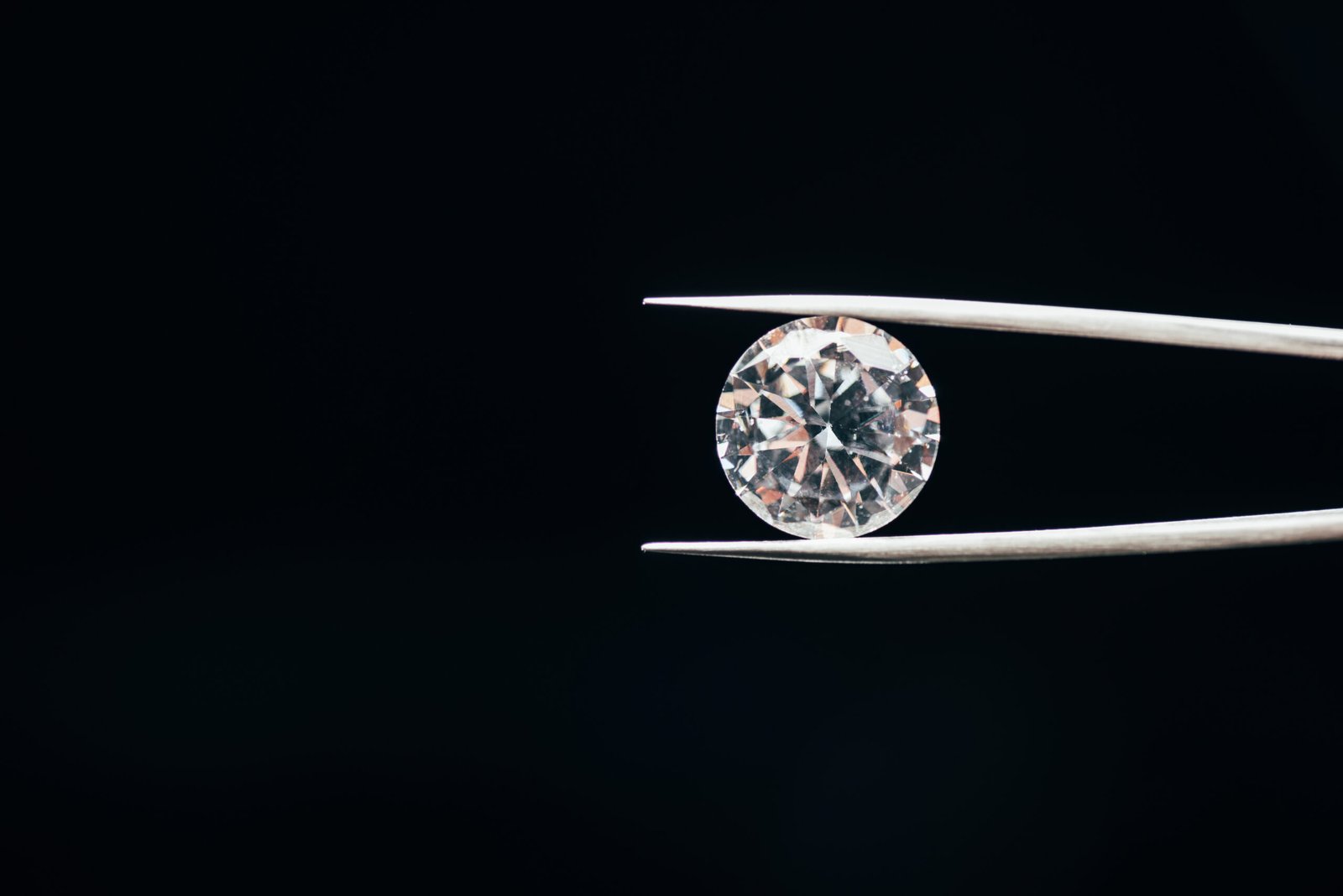
Walk into any jewellery store in Australia and within minutes someone will mention the 4Cs. Cut, colour, clarity and carat are the qualities every diamond is graded on. What rarely gets explained is which of them actually change how a stone looks on your hand, and which quietly inflate the price of a diamond nobody will ever examine under a loupe.
That distinction is worth real money. Two diamonds with almost identical certificates can differ by thousands of dollars. Understanding why is the difference between buying well and simply buying expensively.
Cut: The C That Matters Most
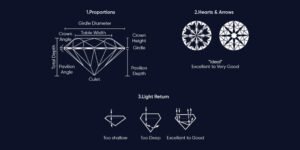
Cut is the most misunderstood of the four, partly because it is often confused with shape. Round, oval and emerald describe shape. Cut describes execution: the proportions, symmetry and polish that determine how efficiently a diamond returns light to the eye.
A well-cut diamond takes light in through the top, bounces it internally between the lower facets, and sends it back to the viewer. A poorly cut stone leaks that light through the base or the sides, and looks flat or dark at the centre regardless of how impressive its certificate reads.
The GIA grades cut from Excellent through to Poor, though this grade is only issued for round brilliant diamonds. Fancy shapes such as ovals and pears have no single set of ideal proportions, so they must be assessed individually, which makes viewing the stone in person considerably more valuable.
If your budget forces a compromise, sacrifice carat weight before cut. A beautifully cut 0.90 carat diamond will outperform a mediocre 1.10 carat stone in brilliance, and often looks the same size or larger because a well-cut stone spreads more efficiently across the top.
Colour: Where Most Buyers Overspend
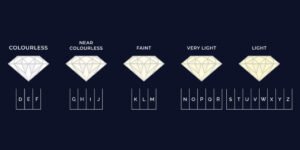
Diamond colour is graded on how little colour a stone shows, running from D through to Z. It begins at D rather than A because the GIA wanted a clean break from the inconsistent systems that came before it.
The critical detail is that colour grading is performed face-down, against a white background, under controlled lighting, by a trained grader using master stones. That is not how anyone will ever see your ring. Once a diamond is set in metal and viewed in daylight, the difference between a D and a G is invisible to almost everyone.
The price difference is not invisible. Moving from D to G on a one carat stone commonly saves fifteen to twenty-five per cent. Spent instead on cut, that saving does visible work.
Metal choice changes the calculation entirely. A diamond set in 18ct yellow or rose gold picks up warmth from the band regardless of its grade, which makes paying for a D to F stone difficult to justify. In those settings, an H, I or even J grade looks entirely at home.
Clarity: What You Can Actually See
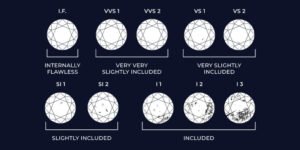
Almost every natural diamond contains internal characteristics called inclusions, formed under extraordinary pressure over billions of years. Clarity grading assesses how many there are, how large they are, where they sit and how easily they are seen under ten times magnification.
The term the trade uses, and the one you should adopt, is eye-clean. A diamond is eye-clean if no inclusion is visible to an unaided eye at normal viewing distance. Plenty of SI1 and even SI2 diamonds qualify, particularly when their inclusions sit near the edge where a setting can conceal them.
Position matters more than the grade letter. A small crystal at the edge of a VS2 stone is far less consequential than a feather sitting directly beneath the centre of a VS1. This is why we assess each stone individually rather than relying on a certificate alone.
Carat: Weight, Not Size
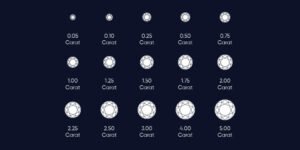
One carat weighs exactly 200 milligrams, or one fifth of a gram. The most common misconception is that carat measures size. It measures weight. A stone cut with excessive depth carries that weight downward, hidden inside the setting, and looks smaller from above.
Pricing also jumps sharply at round weights, because demand clusters there. The trade calls these magic sizes: 0.50, 0.70, 0.90, 1.00, 1.50 and 2.00 carats. A 1.00 carat diamond can cost fifteen to twenty per cent more than a 0.95 carat stone of identical quality, despite a difference in diameter of roughly a third of a millimetre. Buying just below a magic size is one of the most reliable ways to gain quality without gaining cost.
How the 4Cs Work Together
The four are not equally weighted, despite usually being presented as a list of equals. After years at the bench, this is the priority order we give clients.
| Priority | Quality | Our guidance |
| 1 | Cut | Never compromise. It is the only C created by human skill and the only one that makes a diamond look alive. |
| 2 | Carat | If size matters to the wearer, shop just below the magic weights. |
| 3 | Colour | Match to your chosen metal rather than to the top of the scale. |
| 4 | Clarity | Buy eye-clean and stop. Nothing beyond that is visible without equipment. |
A G colour, VS2 clarity, Excellent cut diamond of around one carat will look extraordinary and cost substantially less than a D colour, VVS1 stone of the same weight. To the naked eye, in a finished ring, the two are indistinguishable. On the invoice, they are not.
The Fifth C: Certification
A grading report turns the 4Cs from opinion into documented fact. Reports from the Gemological Institute of America are the most rigorous internationally, while the International Gemological Institute is widely used, particularly for lab-grown stones. Grading is not perfectly uniform between laboratories, so when comparing two diamonds always confirm they were assessed by the same institution.
Australian owners should also obtain a separate insurance valuation. This establishes replacement value for your insurer rather than assessing quality, and should be updated every few years as prices move.
Bringing the 4Cs Into Your Own Design
The point of the framework is to let you direct your budget toward what you will actually see, and away from what only a laboratory can measure.
At Adorne, you hand-select your stone from our own in-house inventory of diamonds, sapphires, emeralds and rubies, with each of the 4Cs explained openly rather than used as a sales device. Once your stone is chosen, we translate your design into a precise 3D CAD render so you can review proportions and stone placement before any metal is poured. Your finished piece is then cast, set and finished here in Australia.
Book a consultation with Adorne to explore our gemstone inventory and begin your bespoke design.